Page protection
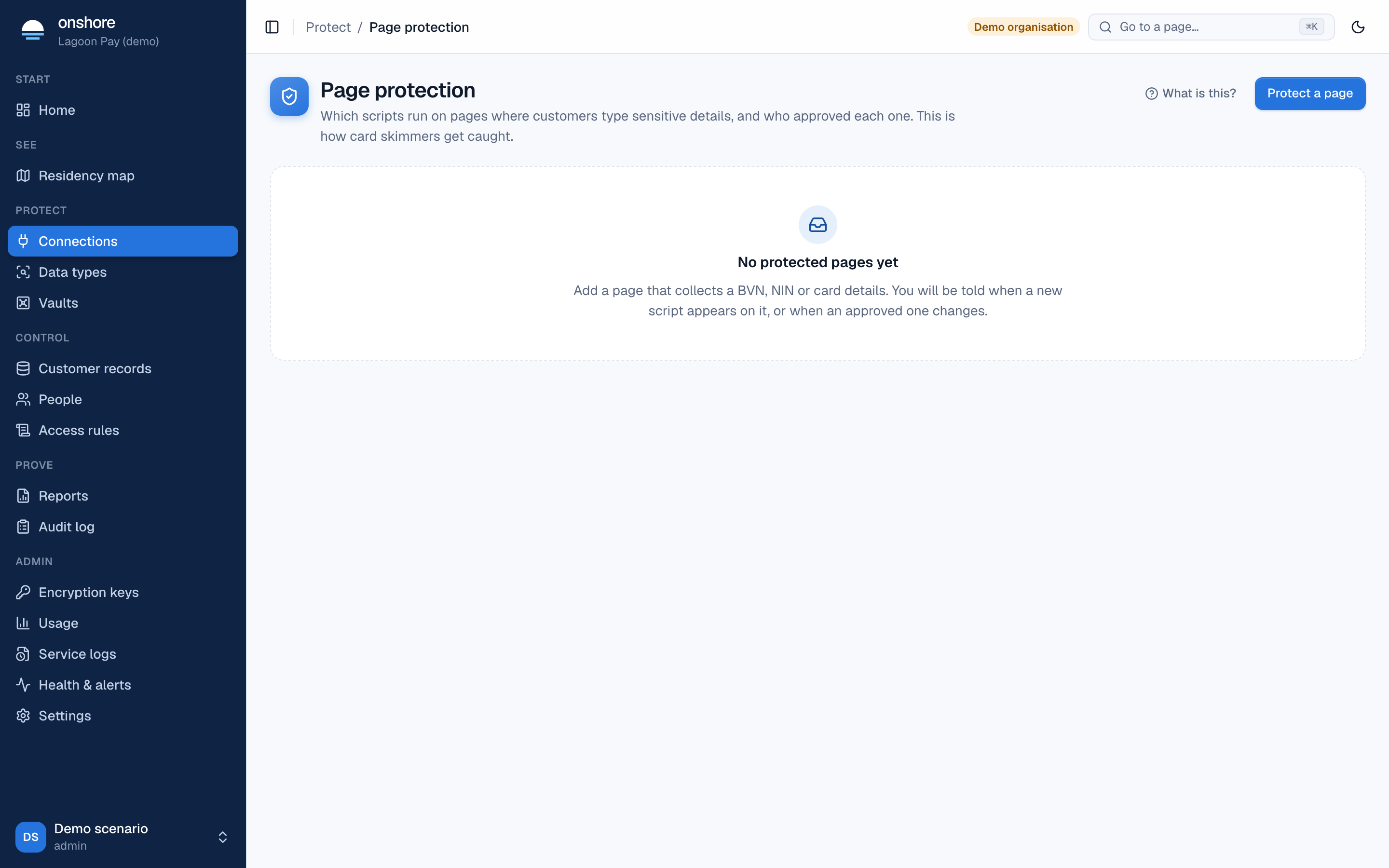
A checkout or KYC page can be emptied by one compromised third-party script. Page protection keeps a list of what runs on your sensitive pages, and tells you when that list, or a script’s contents, changes. It supports the script inventory and change detection that card-payment rules ask about.
This hasn’t been assessed against any card-industry standard, and using it doesn’t make a page compliant.
Protect a page
Add the page
Select Protect a page and enter its address.
Report only
Send the header shown under 1. Report only on that page. Browsers report every script, and nothing is blocked.
Add the watcher (optional)
Add the snippet under 2. Watcher to catch scripts added after the page loads.
Decide on each script
Browse the page. Scripts appear as need a decision. Approve or reject each one with a reason. Approving records the file’s fingerprint (SHA-256).
Enforce
When the list is right, use the header under 3. Enforce. It blocks anything not approved, so try it on a staging page first. Your own inline code needs a nonce.
Select Scan now to fetch the page from the server immediately. Scans also run every 15 minutes.
Three ways scripts are seen
| Signal | Sees | Weakness |
|---|---|---|
| Browser report (the header) | Everything the browser loads, including inline code | You must set a header; some extensions block reports |
| Watcher script | Scripts added while the page runs | A hostile script on the same page could interfere |
| Server scan | Script tags in the page’s HTML, and each approved file’s fingerprint | Only what an unauthenticated request gets; misses pages behind a login |
Alerts
| Alert | When |
|---|---|
| New script | A script not seen before on this page |
| Script changed | An approved file’s contents changed. It loses its approval until someone looks again |
| Rejected script seen | A rejected script ran again, at most hourly |
| Report flood | More than 50 new scripts in an hour, or 500 on a page |
Each also sends a webhook event.
What is stored
Script addresses only. Query strings and fragments are dropped, and a path segment holding ten or more digits or an @ becomes [removed]. The watcher reads script addresses and nothing else: no form fields, cookies or page text.